

Since ChatGPT was launched 3 years ago, we have been wondering how and when online buying and decision-making journeys would change.
There is still no reliable research showing whether generative AI platforms are replacing Google or how many final buying decisions are made through ChatGPT or similar tools.
JOIN US to discuss this topic LIVE on Linkedin or Youtube and bring your questions!
ChatGPT is still sending very little traffic, compared to other channels. According to Ahrefs data, traffic from AI platforms accounts for 0.43% of overall website traffic, on average. This number aligns with my own data. The best-performing niche, in my experience, is technology, where AI traffic may reach about 0.7% of the overall traffic.
With such a tiny amount of clicks, a lot of brands are asking the same question: “Should businesses even invest in something that doesn’t seem to yield any measurable results?”

Marie Haynes, a well-known SEO practitioner, published an article claiming that “GEO is a distraction”, which triggered lots of discussions that Barry Schwartz summarized here.
So should business owners prioritize SEO or GEO?
AI Visibility Cannot Be Measured by Clicks
This is a common argument from marketers defending GEO as a valid, separate strategy, and I agree with it.
Traffic is not a valid KPI for something that is not meant to trigger a click. AI Answers are designed to give a satisfactory answer right away, removing the need for a click.
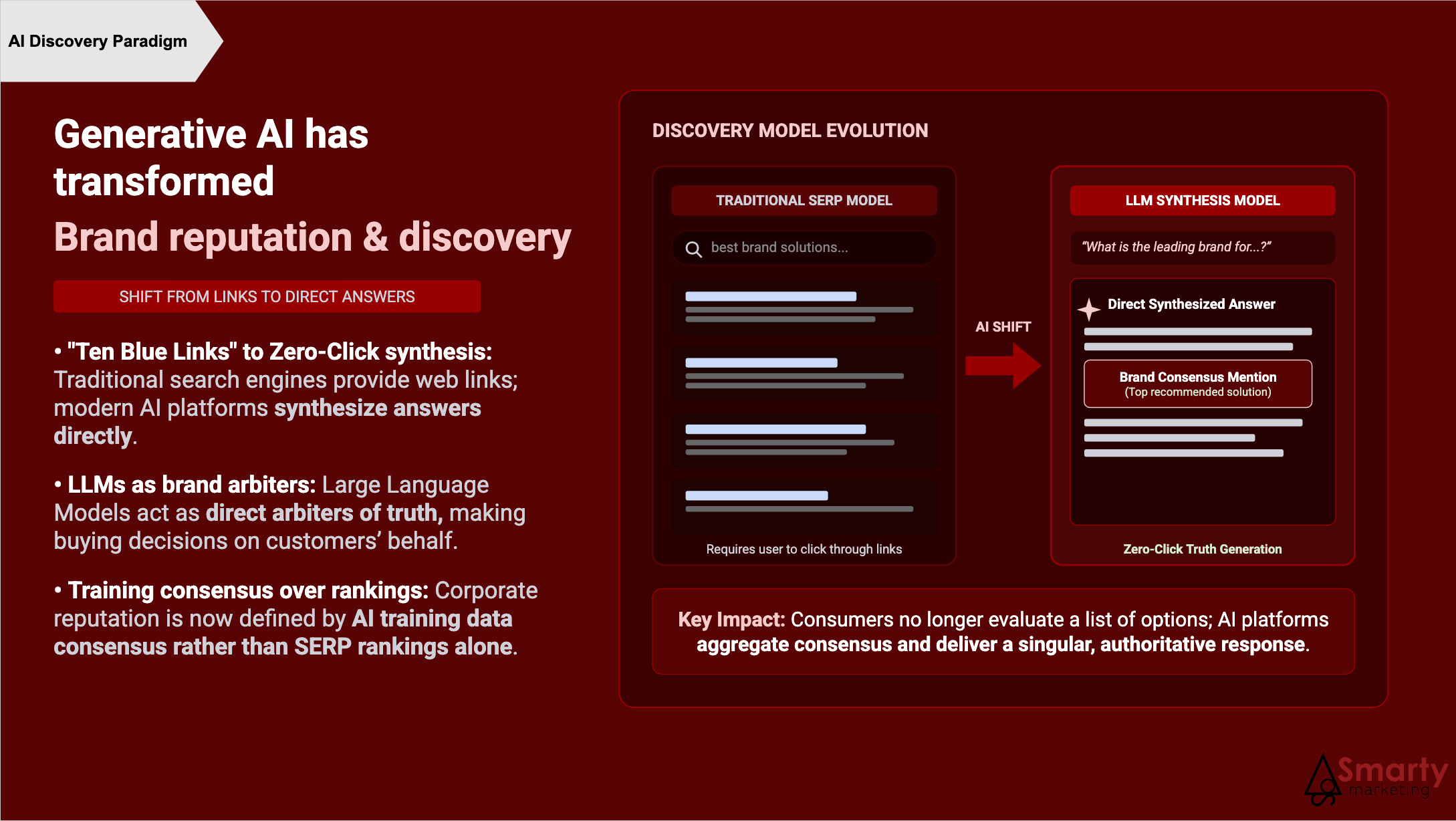
But the problem is, we don’t really have any other reliable means of measuring the success of a GEO strategy. Businesses are currently using a combination of metrics, none of which gives a clear visibility picture:
AI visibility score assigned by a third-party tool (like Profound or PeecAI). This number heavily relies on the prompts you track and can be easily skewed. If you add prompts that mention your brand/product name or include your narrow expertise, this number will dramatically increase. For example, I am seldom mentioned in an AI response to the “Top SEO experts” prompt, but if I start tracking “Top female SEO experts”, my AI visibility score will be high. We don’t know how real people prompt, so assigning a visibility score to our own synthetic prompts doesn’t give us any definitive answer if we are actually visible. [In my next newsletter, I will share other, more useful and practical metrics and KPIs we can obtain from AI visibility tools, so stay tuned!]
AI traffic: Comparing a ~30% traffic channel to a 0.4% traffic channel to measure the performance of the latter is not a good idea because the numbers are too low and will inevitably result in a very low amount of sales.
Branded queries and branded query impressions: The theory is that AI visibility should result in more people searching for your brand name (because many brand names are not linked in AI Answers). This might be true but for smaller businesses, the number of impressions for your branded queries will increase so slightly that it will be hard to even measure. For bigger brands that invest in lots of paid ads, the increase of the branded traffic can often be explained by one of those campaigns, so the correlation with AI visibility is never clear.
Many businesses now integrate “Where did you hear about us” surveys in the on-site buying journeys. This is a great idea but it can be a distraction for site users.
Plus, it will only yield reliable results if a customer makes a purchase right after interacting with an AI platform. If they found out about your brand from ChatGPT and remembered to buy from you the next day, they may fail to tell where they discovered your brand or product. Plus let’s not forget about the primacy effect (when people are presented with a list of options, they are disproportionately more likely to select the first few choices).
So this is also not a perfect measurement solution.
And yet, we know and see LLM platforms grow in popularity and demand. It is not exactly a channel any business can ignore.
With a lack of attribution and reliable measurement options, how can businesses justify their GEO investments?
There’s no perfect answer, but here’s my perspective:
1. SEO should remain the priority
There are two main reasons for that:
Google is still the only intent-based organic findability channel that can be measured (and that still drives the majority of organic sales). While GEO metrics are still a black box, Google’s numbers are clear and predictable.
Organic search visibility is the most predictable route to AI visibility. The correlation between top-ranking URLs (in Google) and top-cited URL (by LLMs) is unknown and also very platform-specific. ChatGPT tends to cite bigger publications (many of which happen to be OpenAI partners) and UGC (like Reddit), while Gemini and AI Mode rely on Google’s index. There have been many reports showing ChatGPT-cited URLs do not rank in Google that well. One older study from Ahrefs reported a mere 12% overlap between top-ranking URLs and AI citations. And yet, even if this number is correct, it is higher than any other “GEO tactic” can offer. No other GEO effort yields predictable AI visibility results but SEO. I haven’t seen a single website that would rank well in Google and have 0 visibility in ChatGPT.
Until we have any reliable data proving that AI Visibility actually pays off (and how much), SEO (organic search visibility) should remain the priority also because LLMs search, and they will find your brand if you do good SEO. So SEO is good for both channels.
And yet, I do believe that GEO is not exactly SEO, and there are extra steps to take to be mentioned in AI Answers. These “mostly GEO” tactics include:
Clean and clear websites that are readable without JavaScript (for SEO, it is essential too, but search engines have become more advanced, and they don’t need as much help crawling and indexing websites as LLM agents do)
Cross-channel visibility (because LLMs tend to seek more diverse sources when answering prompts. If your brand is visible and findable across several channels where your target audience is, it has a higher chance of being mentioned or cited)
Cross-channel messaging alignment (LLMs seek consensus when defining your brand, so unclear or outdated copy can result in lower visibility)
Positive digital footprint: LLMs may not recommend your brand in an AI answer if it has a negative online reputation.
So how to justify these GEO efforts without access to measurable attribution?
2. GEO strategies should always include other channels
Do not invest in a tactic that is only “for GEO”, simply because you won’t be able to measure the effectiveness. Besides, different LLMs tend to disagree on which brands they mention, so there’s no straightforward way to be visible everywhere.
Everything you do for GEO should also result in additional benefits elsewhere (which should be prioritized). For example, if you heard Reddit was beneficial for GEO, don’t invest in Reddit visibility just for the sake of AI visibility. Instead, build Reddit visibility first. This will result in brand awareness and sales directly from Reddit, in the first place. And it will inevitably help GEO, as well.
Or, if you heard that list-type articles (listicles) were good for AI visibility, prioritize your listicle outreach based on the traffic and authority of the website. Being mentioned in a high-traffic listicle will drive direct sales. And it will result in better AI visibility, too.
Prioritizing “real” measurable visibility will give you more data to evaluate the effectiveness of any tactic. And this strategy will also gradually increase your AI mentions and citations.
Tool that we started using for AI visibility initially suggested a set of prompts that included brand prompts too, and thus visibility was higher. Now, we ensure that we are tracking non brand prompts only. I believe this is still a better way of measuring performance.
The tracking prompts is interesting to me. I feel we are trying to track them with phrases like we did for the keywords before. But I really don't think people prompt that way, they are more contextual, more question oriented than the old keywords. Just something I had thought of.
It's still about visibility which is one reason I have started saying the Visibility Engines. or the Answer Engines. People interact with them differently than they old Google search. However, I would argue that people started searching with voice more and its a bit more like they are using AI to search now.
Tracking isn't easy now with all the roadblocks. The best thing to measure IMO is revenue along with LTV. But yeah, its what SEO should have been all along.