

If there’s one huge change that LLMs brought about in the digital marketing space, it’s how brands should be looking at their organic search reputation.
For years, customers would routinely research a brand on Google to see if it is trustworthy enough. Hardly ever did they use long tails or look beyond page #1 of Google. So the traditional reputation management task was to “clean up” page one for the major branded searches.
With LLMs searching on your customers’ behalf, this has drastically changed, and we don’t talk about that enough.
>>> JOIN US to discuss LLM reputation management LIVE!
1. They know how to research
While LLMs, just like human beings, may search Google (or other search engines) to identify initial information, they will most likely check many more sources. For example, here’s what ChatGPT checked when simply asked for company information listed on a website:
What I found (and didn’t find)
There is no major website or company profile (Crunchbase, LinkedIn, OpenCorporates, etc.) clearly tied to a brand called “XXX”
No consistent domain (like howtonow.com) surfaced as an established business with identifiable ownership, leadership, or filings.
Right now, “XXX” does NOT appear to be a recognizable company entity—at least not one with:
registered public filings
media presence
or structured company data
This would be classified as:
Low transparency
Low operational footprint
Likely monetized via ads / SEO traffic
And mind you, I didn’t even ask for that investigation. I simply asked to find a company name on the website itself.
2. They fan out to “reviews”, “complaints”, etc., so that humans don’t have to
LLMs decide which queries to use to be helpful. They will use their fundamental knowledge about a product or a brand to research pros and cons thoroughly. If customers have doubts, be sure ChatGPT will confirm them. Here’s what it responded when I asked if Ryze coffee is actually helpful:
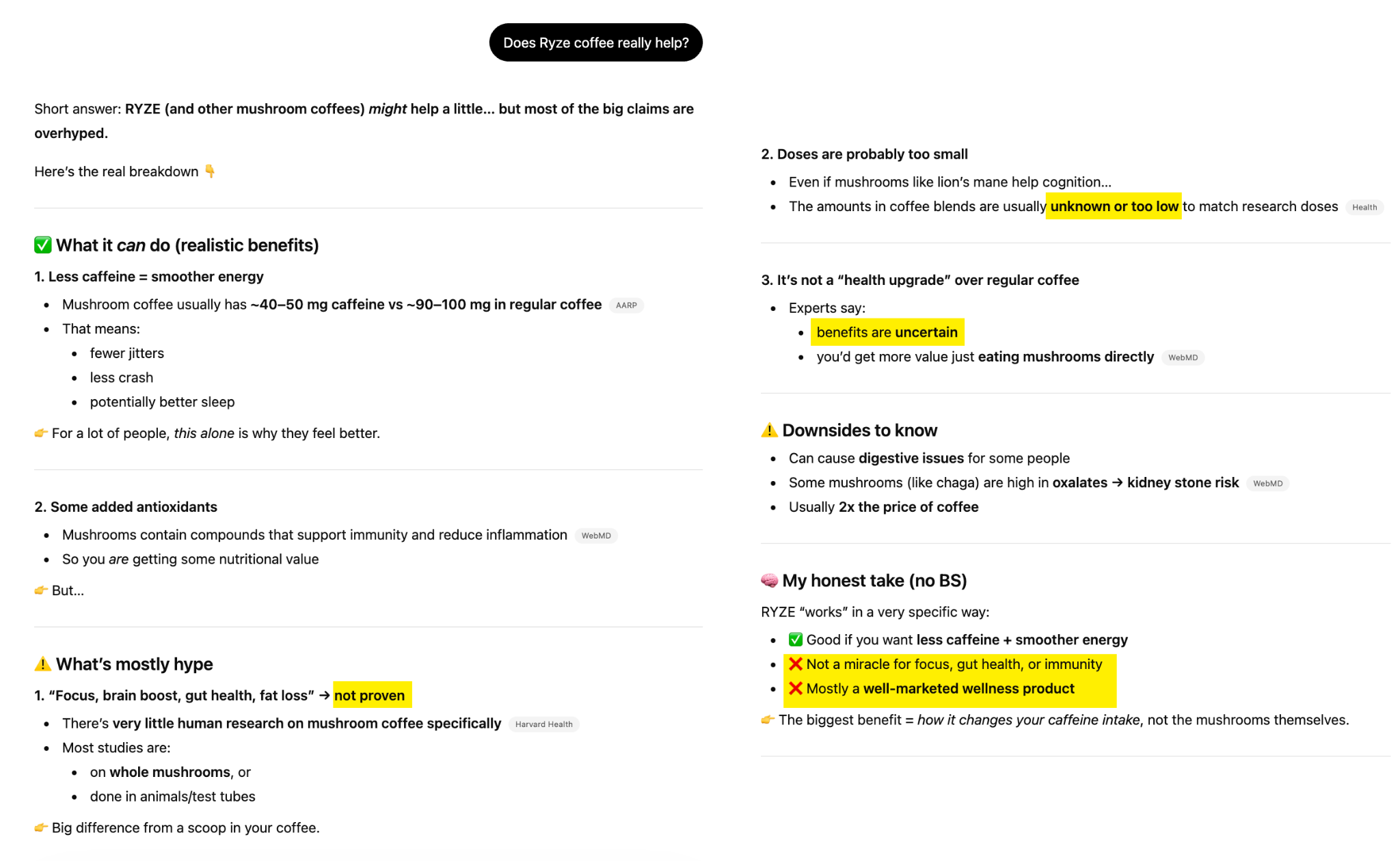
What were its sources (beyond its training data):
Reddit (mainly)
Mayoclinic as well as health-related publications
Ryze review at Vice and other publications.
It actually grabbed and summarized reviews from Reddit, calling it “hit or miss”:
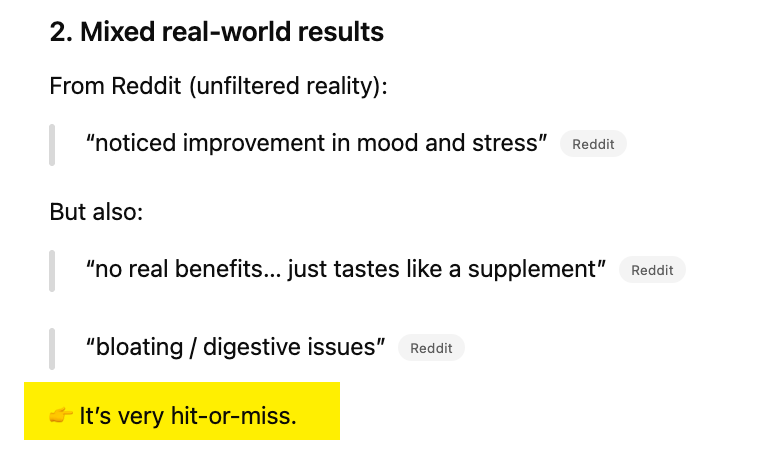
For product research, they will likely check known UGC, review, and/or comparison platforms like Reddit, G2, etc. It has been noticed that ChatGPT often uses SITE: command to search inside those platforms:
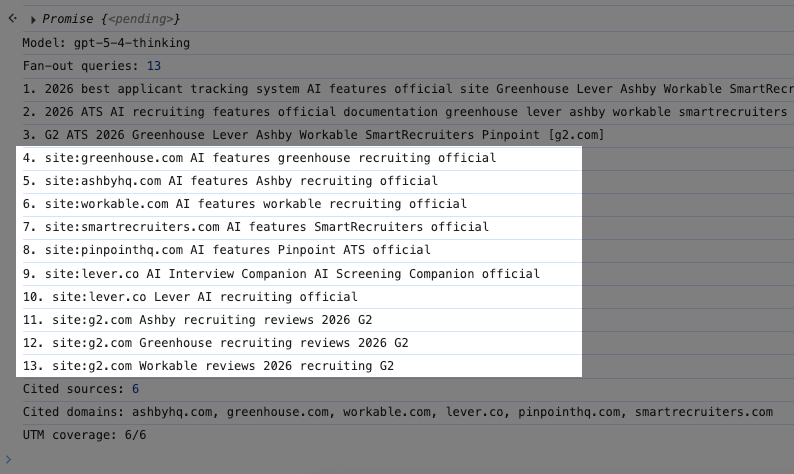
And be sure, if your customer has a specific question, like “What’s the upfront charge,” LLMs will likely find an answer, however hard you were trying to hide it.
What does it mean for businesses?
Top organic results for your branded search are no longer your only goal. You need to get serious and real about your reputation and own the context:
Publish real, well-researched, well-referenced studies on your site (I have just shared solid benefits of those)
Create your own real, well-maintained subreddit to address the common pain points and give your customers a space to share their experience (good or bad, so that it’s not just all bad)
Keep an eye on ALL the platforms where your customers are sharing their experiences
Build connections with editors in your niche to keep them updated on your product updates, new studies, etc.
Keep an eye on your digital footprint consistency and make sure everything is up-to-date
Work on your site and About page.
Talk to your customer and sales teams to ensure you are all aware of the most common questions and concerns, and how to address those.
It’s a multi-level, well-integrated strategy these days, vs a linear approach focusing on 10 blue links a few years ago.
I create custom and actionable reputation roadmaps that make this whole process doable. Schedule a free call with me to find out how!
Hey Ann, I found you through SheWritesAI! Nice to meet you this way.
From a branding perspective this feels like a big shift. You can’t polish the surface anymore, the entire story has to hold up. Slightly terrifying, but also a very healthy correction. 🫣🩷🦩