

In its latest (obviously) well-discussed AI SEO guidelines, Google is introducing a new term: non-commodity content.
Google has long been struggling with the definition here. There was helpful content, there were hidden gems, but nothing that would express an idea in a practical way: You need content that is unique enough for it to deserve a click and attention.
Join us to discuss this topic LIVE and bring your questions!
So what is commodity content, and what is non-commodity content and which one do you mean? (Spoiler: I think you need both)
What is “commodity” content? And what is non-commodity content?

As Google’s AI defines it, a commodity is something basic and raw that can be bought and sold in commerce with two key characteristics:
Its value is the same no matter who produces it (e.g., one barrel of oil is the same price regardless of who sells it)
It is never a final product (it is used to produce more complex goods). If we extend this terminology to content, commodity content is something that be easily repackaged in an AI answer.
Well, in other words, it is ~90% of content that is being digitally produced these days (actually likely much more than that with AI generating this type of content within seconds).
It is also what, ironically, LLMs have been training from so far (that’s why they needed Reddit so desperately).
The non-commodity content, as a term, was first introduced by Danny Sullivan (thanks for the slide @Jean-Christophe Chouinard). I am pretty sure Danny actually came up with the term because it sounds like him very much :)
Here are the actual examples:
Running shoe store content:
❌Commodity content: “Top 10 Things to Consider When Buying Running Shoes” (Standard advice on sizing, arch support, and cushioning).
✅ Non-commodity content: “Why This Customer’s Shoes Collapsed After 400 Miles: A Wear Pattern Analysis” (A deep-dive video analyzing the wear pattern on a customer’s shoes after 400 miles, explaining exactly why their specific gait caused the foam to collapse laterally.)
Real estate business:
❌Commodity content: 7 Tips for First-Time Homebuyers (General tips on pre-approval, location, and budgeting.)
✅ Non-commodity content: Why We Waived the Inspection (And Saved $15k): A Look Inside the Sewer Line (A breakdown of a specific bidding war you won last week: “We offered $15k under list but waived the sewer scope because I personally crawled the line and saw it was PVC, not concrete.”)
Interior design business:
❌Commodity content: 2024 Kitchen Trends You Need to See (Photos of green cabinets and brass hardware found on Pinterest.)
✅ Non-commodity content: Marble vs. Grape Juice: Why I Refused to Install Stone for a Family of Five (A video explaining why you refused to let a client put marble countertops in a house with three toddlers, showing the stain tests you did with grape juice and turmeric to prove your point.)
Non-commodity content is experience-driven and unique
It cannot be summarized in an answer without giving you prominent credit. That is the biggest part I see here.

Expertise is becoming a commodity. LLMs have expertise.
What they don’t have and never will is experience.
But the thing is, like Gus Pelogia stated, experience can be commoditized too, once it becomes part of training data.
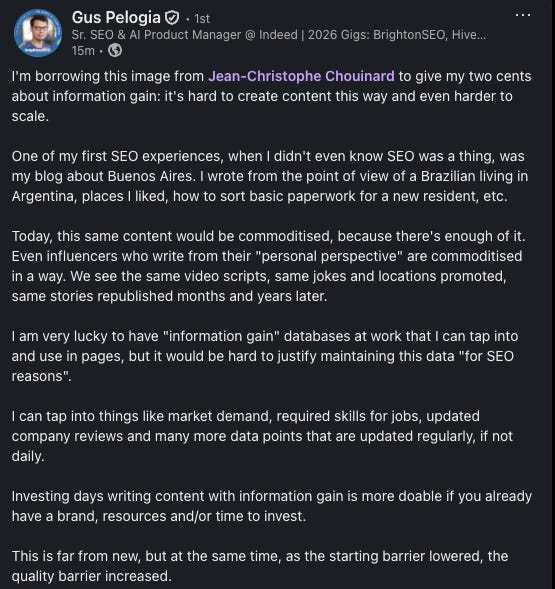
It is a very fine line between providing non-commodity content and making it seen enough for it to become common knowledge…
So what to do?
You become the SOURCE…
It has always been key to building the authority (which drives all other visibility metrics) but it is talked about more these days.
If you are the source of the data or a finding or a trend, your name is much harder to erase from the summary. You are not one of the voices. You are THE voice.
I’ve talked about this a lot: You need to be investing in proprietary research. Your own data is what makes you unique. But it is also not just about building, it is always about doing it right (why would anyone care about your study?) and putting it in front of people who will find it interesting enough to spread,
It is good old content marketing with a new name.
So is “non-commodity content” all I need to publish now?
No
Don’t forget, Google’s guidelines as well as Danny’s presentation are all about SEO (getting you findable in organic search).
The most important SEO strategy out there hasn’t changed at all, “Your site should not exist for SEO only.”
SEO-first approach works until it doesn’t (which usually happens fairly quickly these days).
Your commodity content should exist as long as it helps your users. I am sorry for this commoditized advice (pun intended), but it is still true:
Search engines will like you if your users do. LLMs will like you if your users do.
This is the algorithm we should all optimize for, especially now that LLMs learn and mimic what people do.
Commodity content will help people who are at the beginning of their journey (if you do it right), regardless of how they found it. You need to be helping people at every step of their journey. This hasn’t changed.
So what has changed?
We have a new term to use! As an antonym to “commodity”, “non-commodity content” is something that doesn’t have a universal/flat-rate pricing and cannot be easily repackaged into an AI answer.
But it is not enough. For real impact, your non-commodity content should also make you “top of the voice” in your niche. It will work for organic search and LLM visibility. Otherwise, it may still be commoditized.
If you need help developing an effective content strategy that turns your brand into a destination, ask me how!
Love this. Makimg me think about how much time I spend on each. Great insights!