

What gets a page cited by LLMs?
There’s not much information LLM platforms would provide us with, so we have to rely on patents and independent studies looking at correlations.
Cyrus Shepard has collected all those available documents, found tactics that are most mentioned everywhere, and put together a list of what seems to move the needle.
I decided to take one step further here and create a bridge between traditional SEO and SEO for AI (GEO) to see how things have really changed.
Join us to discuss this topic LIVE and bring your questions!
Note that SEO is being perceived differently depending on who you ask. In my interpretation below, I am talking about traditional SEO as I see it. And as someone who has been in SEO for more than 20 years, I think I am totally entitled to define it.
So let’s look at those GEO correlations and see if it is “just SEO” or if we need to start doing something differently.
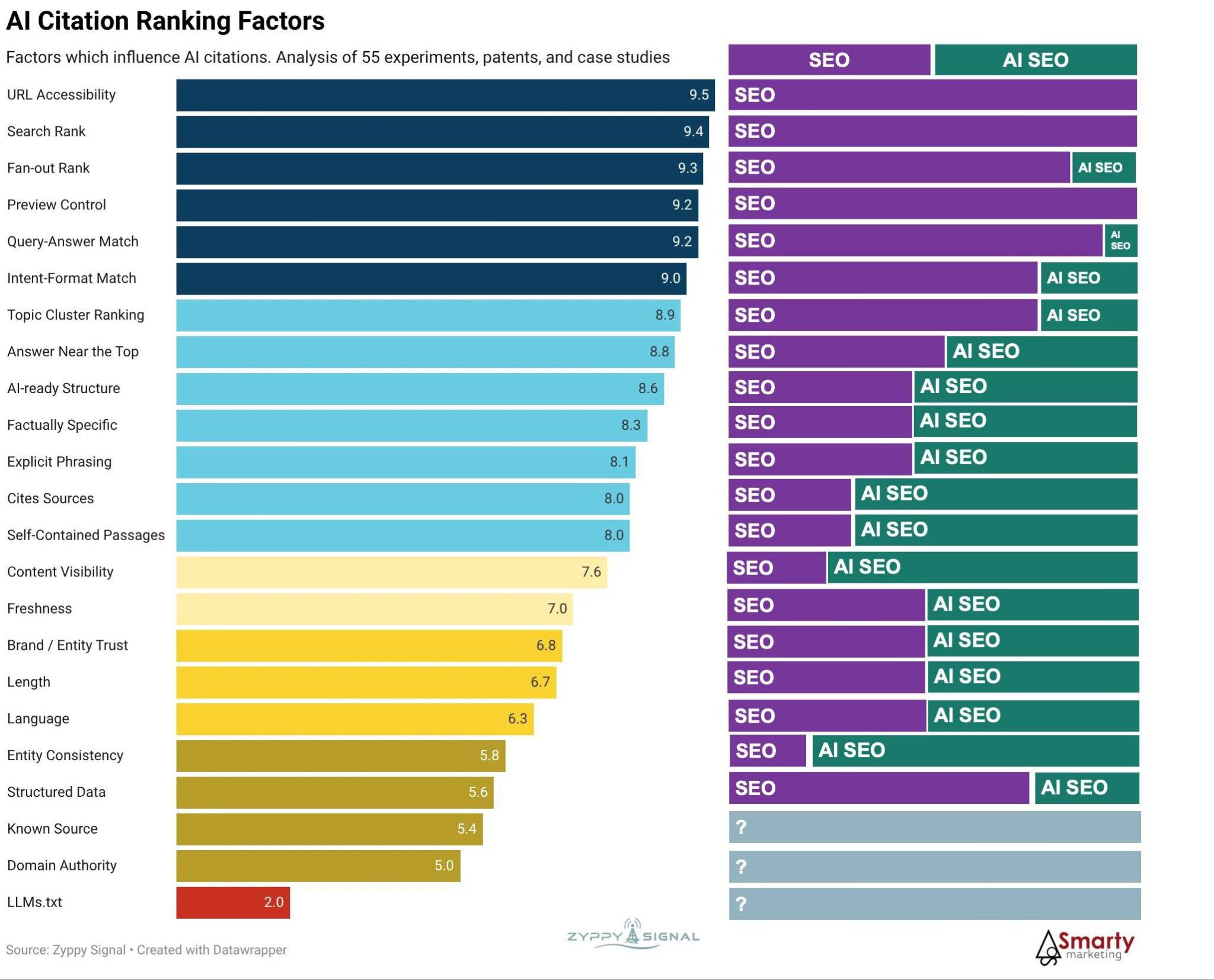
1. URL accessibility = Is the URL accessible to a search / LLM bot?
100% technical SEO, although it is getting a little harder to navigate with more bots that can still access your page, no matter the directions, and new technology trying to control that.
2. Search rank: High-ranking URLs get cited by LLMs
100 % SEO
Not sure if this needs an explanation.
3. Fan-out rank = How visible a URL is for queries that an AI agent is searching for
90% traditional SEO
LLMs choose different queries to search. But these are still keywords…
4. Preview control = What you allow search engines to show their users
I wish we had more than 100% of SEO here.
The fact that LLMs use search snippets is the most solid proof that they depend on traditional search too much!
I have seen many tests showing that LLMs simply cite a search snippet without actually going to the page itself.
5. Query-answer match: Your page should match both the search query and the AI answer
It is, again, 100% SEO, but the term “semantic relevance” is thrown around so much nowadays that I’ll go ahead and give it 95% SEO in case I am missing something.
6. Intent-format match, e.g., Citing listicles when a user is asking for “best” options
We have been talking about intent optimization for many years in SEO. But I’ll give this a 20% of GEO because I think LLMs are just more straightforward with intent than people.
Human searchers may have no intent when searching. LLMs know what they are doing.
7. Topic cluster ranking: Ranking for multiple related queries increases your chance of getting cited
This is 100% SEO because it goes back to traditional rankings.
I’ll give it 20% of GEO just because LLMs do fan out to related queries a lot more. So you need to capture more than “obvious” queries here than in traditional SEO.
8. Answer near the top: Giving a good answer in the first third of your page will get you cited more
“Above the fold” has always been important in traditional SEO.
But I’ll give this one 45% of GEO because LLMs are lazier, so this has become more important than previously.
9. AI-ready structure, i.e., Ask & answer questions on your page like you are explaining things to a three-year-old
Clarity has been important for SEO, but it looks more important for LLMs.
Not a new tactic, but definitely discussed more due to GEO now.
10. “Factually specific”, i.e., Avoid bold claims, stick to the facts
Same as above: It has been important since the launch of featured snippets. But it seems more important for LLMs.
11. “Explicit phrasing”: Avoid vague statements, stick to an active, confident voice
This has also been part of featured snippet optimization, but not necessarily that much discussed.
12. Cite sources (not necessarily linked)
In SEO, this has always been a debate: whether outbound trusted sources add credibility to your page. Many SEO experts recommended linking out to GOV and EDU sources for EEAT…
The effectiveness of this has never been confirmed by any SEO studies (or officially).
In LLMs, there seems to be a consensus that citing sources helps (and studies to support that). Also, sources don’t have to be links.
13. Self-contained passages (+or sentences)
We have been (kind of) talking about this since Google’s passage-based ranking announcement (around 2020), but we definitely talk a lot more about this now.
14. Content visibility, i.e., No hidden content that is accessible through JavaScript
One of the oldest, most forgotten SEO checks: Is the page fully readable with JavaScript disabled? Google has become incredibly good at rendering JavaScript, and I usually skip recommending anything as long as the page looks good in the URL Preview inside Search Console.
It is now fully back, as AI Agents are believed to skip any sections or page elements hidden by JavaScript.
15. Freshness, and the date on the page
It is hard to measure here, so I’ve put 50%/50%.
In SEO, it depends on the query. In GEO, the “freshness” bias may be fully driven by organic search results.
16. Brand entity and trust
I am a little surprised that this one comes at #16
I think being a known and trusted entity is the most important factor for both SEO and GEO.
But I guess it is extremely hard to measure.
17. Length / word count
The debate has existed as long as SEO itself, so it feels like it has entered the “GEO” sector out of habit.
In GEO, though, LLMs seem to have been proven to be too lazy to read further down the page, so the content length debate makes a bit more sense here.
18. Language
Both search engines and LLMs try to surface pages in your language…
LLMs are easier, though. To find pages in your preferred language in Google, you have to change the language settings. In LLMs, you can simply prompt in a different language for it to switch to that language and foreign URLs.
19. Entity consistency
The biggest difference for GEO so far. You need to be consistently described across (and outside of) all possible channels.
Not sure how that could impact citations, but it is definitely important for the answer inclusion.
20. Structured data (schema)
Rich snippets improve clickability, which improves rankings, which improve LLM visibility.
That, or else, pages with schema just tend to be better optimized overall, so they rank for many other reasons.
These are the best ways to explain any correlation between schema and LLM visibility, as far as I can see.
For the lowest three, I am not sure I have an opinion.
The URL is already known to the AI engine via its training data (not sure how this can be measured…)
Domain authority doesn’t correlate with anything these days, so not sure why we still talk about it.
LLMs.txt would be 100% new for SEO if it worked…
If you are looking for help to figure all of this out, I have a free option to connect and discuss!