

Scaling content production has accelerated since the ChatGPT launch. Businesses and publishers are actively saving money on content creation by generating content using generative AI.
There are lots of tools claiming their AI-generated content is “undetectable” and “high-quality”.
Google’s saying, “We don’t care how your content was produced as long as it’s useful,” has been perceived as “Go ahead, and generate your content with AI”.
But is it really the case? All signs point to the opposite.
>>>> JOIN us to discuss this topic LIVE and bring your questions!
Long-term SEOs had already known this cycle: SEO agencies that like profit margins will rush to AI-generate content for their clients → AI-generated content will dominate the web → Google will act. And this is what is already happening as we speak.
So far, everyone who cared to listen and watch has seen lots of signs that Google is actively penalizing AI-generated content:
There are lots of case studies showing websites generating content using AI are being penalized by Google’s Spam Update every year. @Lily Ray has lots of great examples in her newsletter.
There’s a brand new patent on
AI content“AI slop” detection.Google has just updated its official documentation mentioning that any AI-generated OR AI-assisted content should be labeled as such.
All of this was done right before Google’s Spam update, which was longer than any other Spam update so far. I’ve been in SEO long enough to know all of this points to one thing: Google is starting a war against low-effort AI-generated content, and the key here is “low-effort”.
And I said this before: If something is too easy to do, it is neither valuable nor is going to result in long-term growth.
Because everything valuable comes with hard work, and it is not about engineering a sophisticated prompt to generate content. This is a popular argument by those in favor of AI-generated content (and currently in denial that it won’t work).
You may think you outsmarted Google and came up with a genius prompt on how to generate your article, but in the end you are publishing recycled low-effort content, and Google doesn’t like rewarding low-effort.
Content effort and SEO

Content effort is not at all a new concept in SEO.
“Effort” is mentioned 120 times in the official guidelines used by human raters who evaluate Google’s search results. Here’s how content “effort” is explained there:
Effort: Consider the extent to which a human being actively worked to create satisfying content.
Here’s an example of an article that the quality raters’ guidelines encourage to classify as the lowest-effort:


While the content itself is relevant, it simply repurposes other people’s content without providing any sources, adding any expert opinions, or otherwise showing any effort in creating it.
This is a classic AI-generated article that many website owners publish on their websites.
And it is the lowest-rated page, according to Google’s guidelines.
@Cyrus Shepard, who used to work as Google’s quality rater, shares that a lot of attention was paid to content effort during training, and it was always easy to tell low-effort content from high-quality content. He shares some examples:
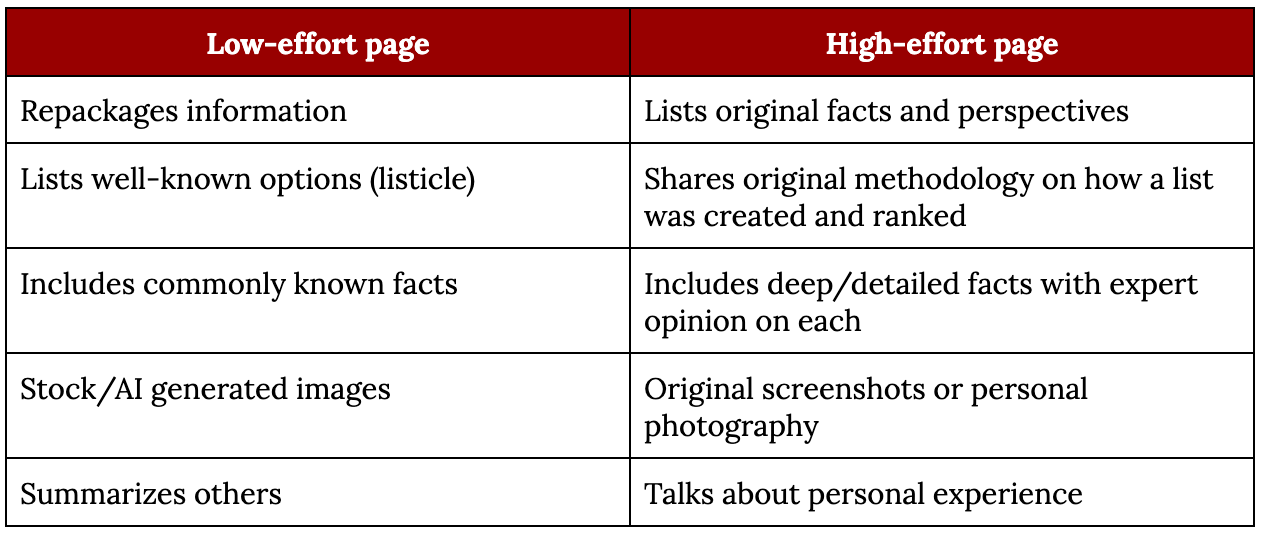
At this point, content effort is also part of Google's official guidelines. Read it twice if that helps:
Effort: The extent to which human work went into creating the content or the systems powering it. For example, writing original analysis, translating a poem manually, or building a custom interactive map for a game represents high effort. Conversely, automatically generating pages from feeds or using generative AI to produce large amounts of text without manual oversight or curation represents little to no effort. Attribution or giving credit to other sources doesn’t replace the need for original effort.
Note: I already shared a similar concept of “non-commodity” content earlier. To me, the distinction is as follows:
“non-commodity” content = your authority-building / data-driven digital PR asset that helps you become the source (surveys, proprietary data, whitepapers). No business can produce too many of these a year.
“content with effort” = your overall editorial strategy for ALL the content that exists on your site (how-tos, reviews, product comparisons, etc.)
Repeat after me:

When it comes down to AI-generated content, it doesn’t matter if it can be detected as AI. It doesn’t even matter if it is actually useful.
Effort is NOT the number of words
Effort is NOT depth of content (AI can do research well)
Effort is NOT the amount of time you were refining your prompt to generate “high-quality content in your voice”
Effort is how much time YOU (or your team) dedicated to the piece to make it truly original (this is key!) because the web is already oversaturated with repurposed content.
What really matters is: WHY would Google or LLMs surface it? Is there anything new YOU added that is worth being found? How is it better than a ton of similar content on that topic???
Content “effort” as part of the algorithm
@Shaun Anderson found contentEffort attribute in the Google algorithm leak back in 2025. We don’t know if it is a direct ranking signal or how much it can impact a website’s visibility, but the fact that it exists in the algorithm is very telling.
The attribute is believed to power the Helpful Content updates and was later refined enough to become part of the core algorithm updates.
So ignoring (or faking) the content effort concept may decrease your visibility algorithmically.
Unfortunately, I’ve seen a lot of (even big) brands switching to AI-generated content production, and low-effort is pretty obvious there.
Reach out for a free review or consultation if you are worried about your content strategy or online visibility.