

Let’s finally discuss something that continues to be an ever-evolving debate in the SEO/GEO industry: Is AI tracking useless, and what do we bring up in GEO/AEO audits?
Let me first answer both of these questions quickly:
No, it is not useless (in fact, AI tracking gives industries a ton of insights that were not easy to dig up in the pre-AI days), and
Brand & product positioning and its sources are the two main things to prioritize in AI audits.
As I’ve said before, “AI visibility scores” are not something I’d even bring up in my GEO/AEO audits for many reasons, one of them being that they are not actionable (so in my perspective, they are pretty useless).
I am a very actionable SEO/GEO consultant, so I tend to ignore metrics that are there just for reporting and painting a pretty picture.
Let’s now elaborate, but first, here are two great events you all should join this week:
@Rand Fishkin is doing an exclusive AMA in our subreddit: Go ahead and ask your questions. Rand doesn’t like being called an SEO but he definitely knows more about SEO and GEO/AEO than any of us! Don’t forget to join the subreddit while you are there because we host lots of great events there! If you ever wanted to hear from real experts, that’s the place!
JOIN us to discuss GEO/AEO metrics and AI visibility tracking LIVE and ask your questions! We stream to Linkedin and Youtube and it is completely free! Come chat with us!
Brand attributes and objectives are the two key metrics to audit and track…
In other words, LLM tracking and auditing should give us the answers to three main questions:
Brand attributes: What is my brand and/or product currently associated with in AI Answers (this is going to be a reflection of what your human customers think of you too, so it is important beyond GEO)
Which of those attributes are “objections”, i.e., what negative sentiment can advise LLMs or human customers against buying from you?
What are the main sources of both? This is what informs your strategy going forward. You’d be surprised how often the brand’s official site is the main source of #2!
Let’s take a closer look at all three of these:
Brand attributes (brand’s perception)
In most cases I’ve seen so far, what a business owner wants their brand to be associated with, and how it is associated in real life, is vastly different. AI visibility tracking and GEO/AEO audits give you ways to identify and fix that gap like nothing did before.
I had started prioritizing this analysis before AI tracking tools caught up, so I used to do this manually. The workflow here is pretty clear:
Ask Google* to compare your brand or product with your direct, niche-specific competitors (reminder: Avoid huge cross-niche players like Amazon or Salesforce in these comparisons, as we are not going to compete with those)
Check AI Overviews and AI Mode, and make notes of the attributes you see, for example, target audience, price points, features, etc., for both you and competitors.
Note which of the competitors (or yourself if you are lucky), tends to be recommended more, and why.
Ask the same question to ChatGPT, Claude, Perplexity, etc*.
Take the same notes
*When prompting all those platforms, don’t forget to use an incognito mode (in Google Chrome when searching) to erase personalization. Also, run the same prompts when logged out, when logged in, when using a free plan, when using your paid plan, etc.
In most cases, you will see all the platforms give you a very consistent picture when it comes to your brand’s associations, as compare to the competitors. Citations will vary. Some answers will be more detailed than others. But the higher-level picture will be pretty consistent.
I start with Google because, in my experience, it is going to be the most correct and complete picture (Google does know better). What I usually see here:
Google usually understands your digital footprint better
ChatGPT knows less, but the answers tend to be more conclusive (it will proactively recommend one or two options to the end user, while Google tends to let the end user decide, unless you follow up)
Claude is somewhat easily confused, especially when searching. Claude is best used to identify potential brand confusion issues to fix.
Perplexity will change its mind often because it doesn’t have strong training data to balance with search results.
So I use Google first and then cross-compare its findings with others. Your goal here is to create a comparison table that will highlight your brand attributes across different categories you want to be known for, and make it easy to see (so omit little details here; you will get back to those when doing it for the 100th time :) in the future).
Here’s an example of the comparison I did 100% manually, a couple of years ago, comparing different solutions across different associated categories. Here the goal was to be better associated with more categories:
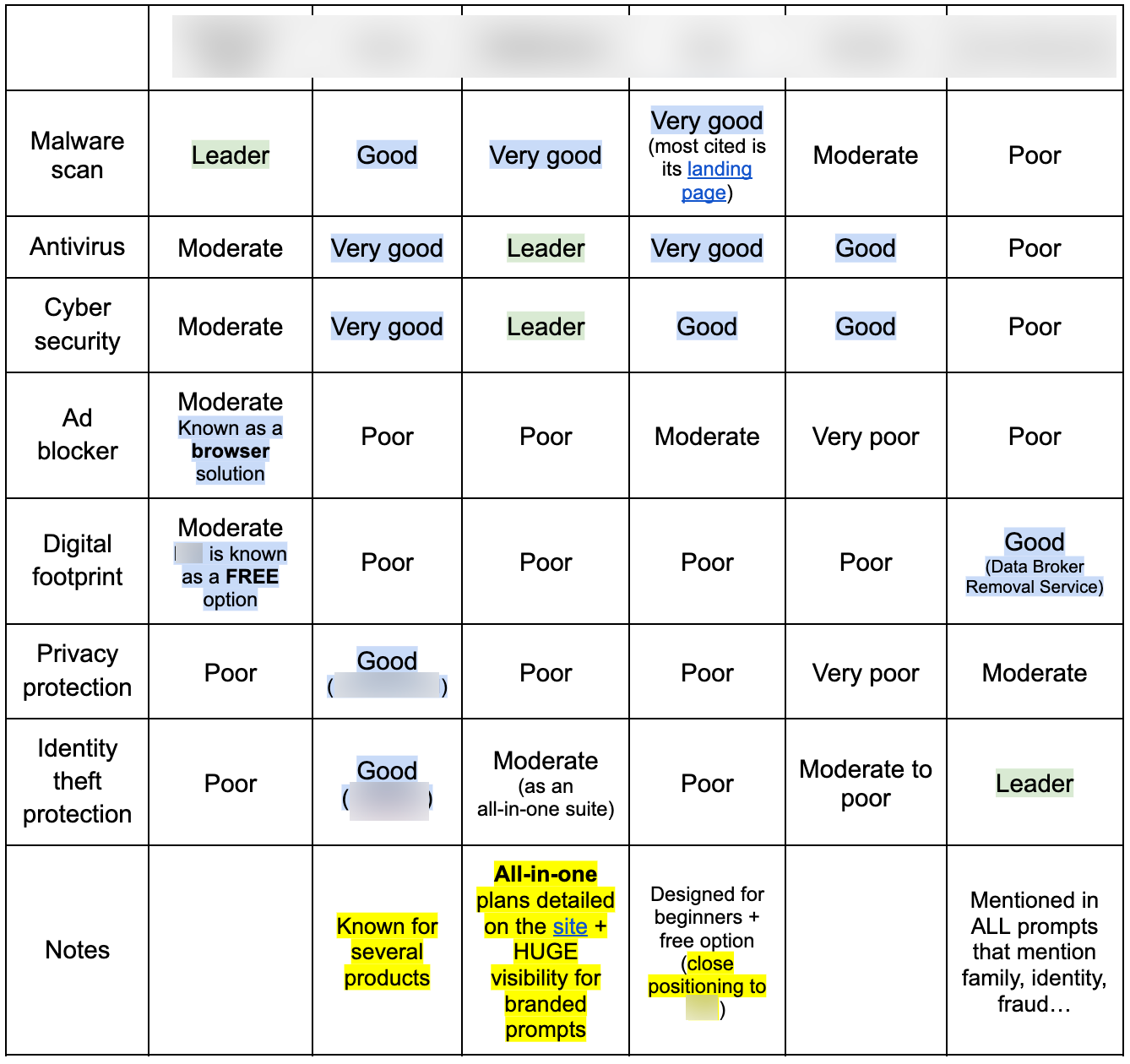
What’s funny, in most cases, what I hear from teams in response to this comparison is, “We knew it but had no means to prove” :)
Brand’s “objections
Now that we know the overall picture, let’s focus on why LLMs may not recommend our brand, omit it from the answer, or advise against dealing with it.
Here comes the LLM reputation component, which is so often neglected by brands because they have lost hope of fixing or controlling it. Well, bad news: “Objections” (negative digital footprint) may cost you AI visibility. You cannot neglect it anymore.
While running those comparison prompts, focus on the negatives around your brand mentions, for example:
Higher price point
Only good for newbies
Isn’t an advanced solution
Slow or inefficient customer support
Good for XX, but not for XX
Etc.
Now that the AI tracking software has caught up with the industry, you can track these inside your favorite AI tool. Using a tool will let you track those objections and their sources, but you can create an initial analysis manually.
This is how Peec does it, for example:
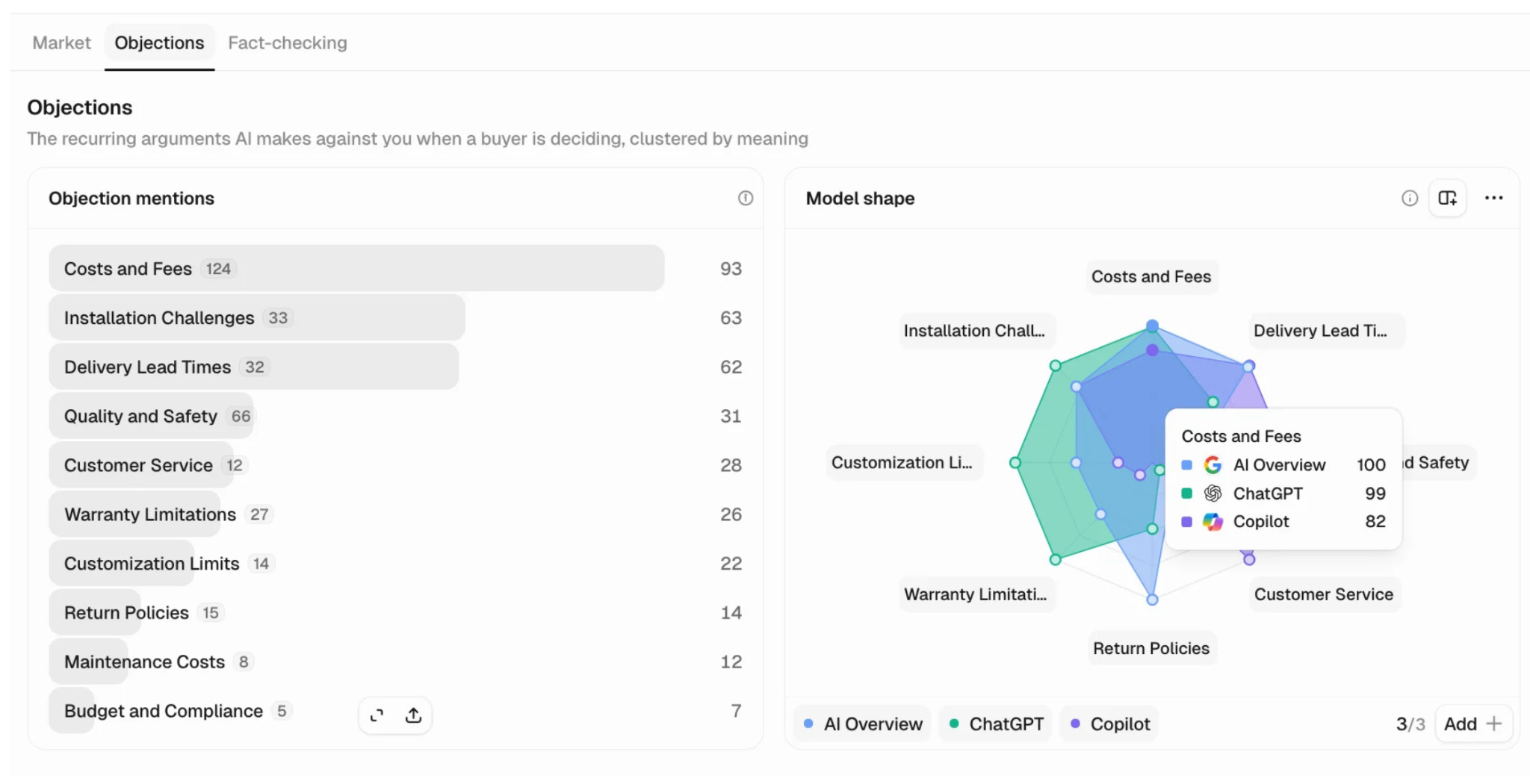
While I do use the AI tracking software, I run dozens of manual runs. Just like in SEO (where I manually search for target keywords to better understand the context), manual prompting gives me a much deeper understanding of brand positioning.
Your objectives can fall into different categories, and each category may require a different strategy:
Your true attributes: Add clarity and context to them. If your objective is higher pricing, you need strong attributes explaining it to be more visible (e.g. you charge more because you have more experience and expertise, or your products are organic or cruelty-free, or you have science-backed patents your competitors lack, etc.)
Outdated pain points: If your negatives have been resolved, they may live in your outdated footprint for years and decades. These are to be cleaned, over time.
Your true objectives to be fixed. Things like customer support failures should be owned and explained. But the only way to get rid of these is to take measures and improve your service. Otherwise, these will keep coming up in your digital footprint.
The goal here is not to erase what’s wrong, outdated, or unpleasant. Your brand’s digital footprint is here to stay, it is also all in the training data. The goal is to shift and control it better. So here comes my main KPI: owning your LLM reputation.
Sources of the brand’s perception
This one is going to be trickier unless you have an AI tracking workflow because citations are dynamic. What you see as a source of the objective today may be replaced by another citation tomorrow, without changes in the overall in-answer sentiment. So here, you need to see the bigger picture.
You can use Peec or create your own automation using Claude Code + individual platform APIs. Whichever you choose, take note of:
Your site pages that mention those objectives without giving useful context (e.g., why your pricing is higher than competitors)
Your social profile or directory listing descriptions that cause confusion or mention objectives. This and the above one are your priorities to fix.
High-authority listicles or articles positioning your brand in a way that highlights those negative points. These are to build relationships with and ultimately reach out to.
Competitors’ pages that mention you in a way that is confusing or negative. These are to be buried 🙂
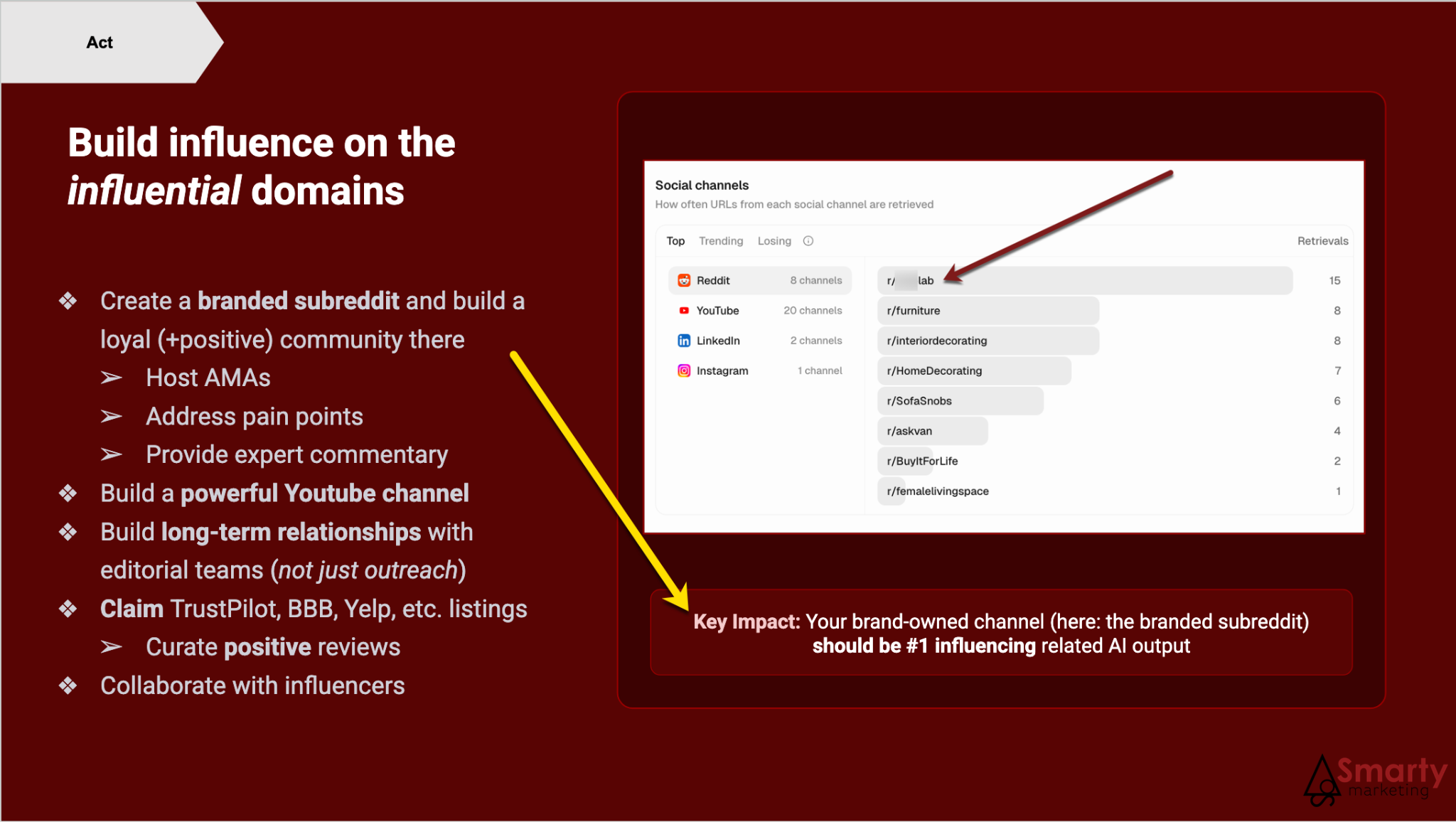
Social media platforms that are making the biggest difference. Your goal here is to create your brand presence on those sites that’s big enough to be more visible than everything else.
The success metric here is seeing your own channels (your site, your social media channels, your claimed listings, articles you wrote, interviews you gave, etc.) to be the growing and ultimately the biggest source of influence for your branded and comparison prompts:
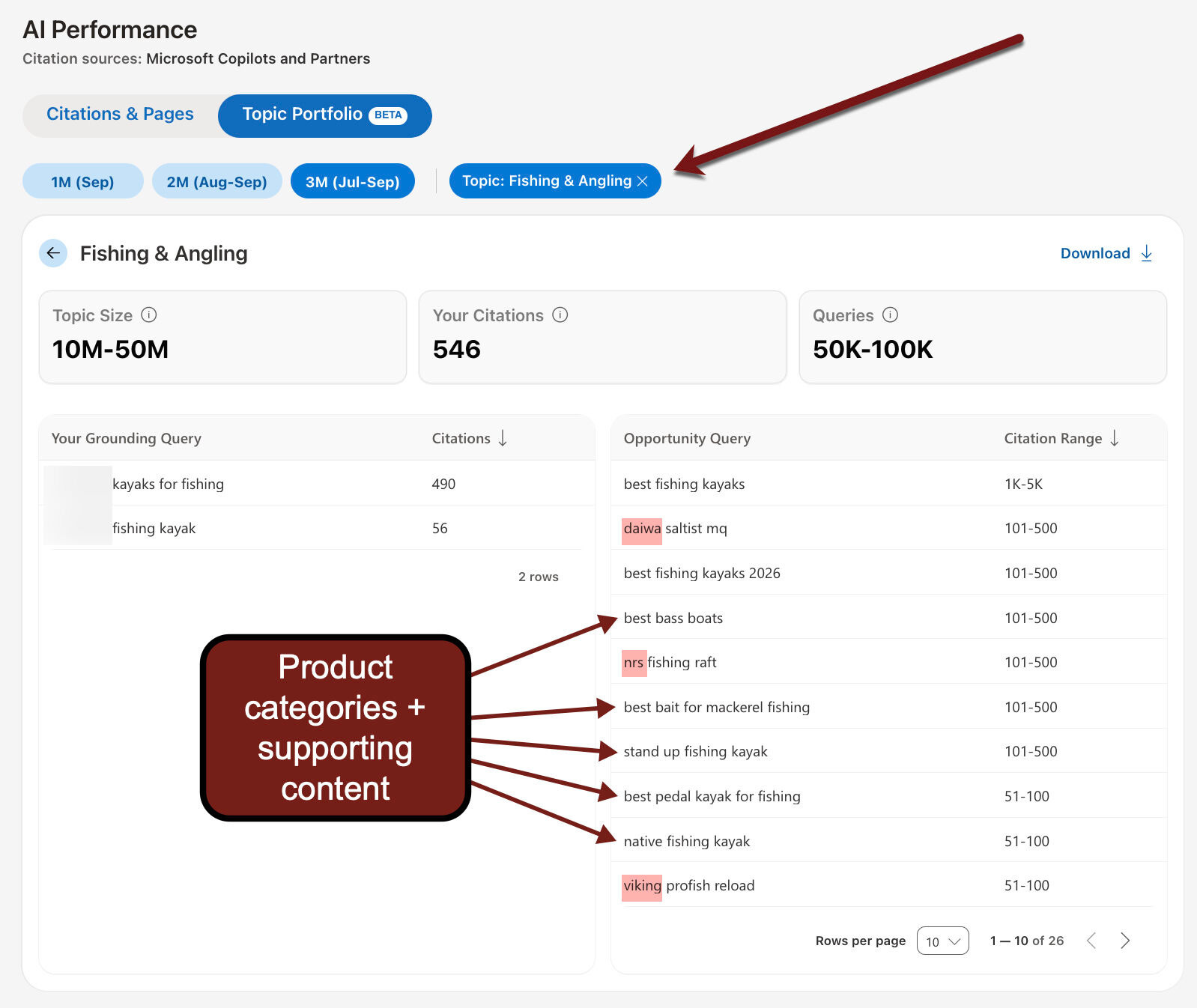
LLM fanouts (grounding queries)
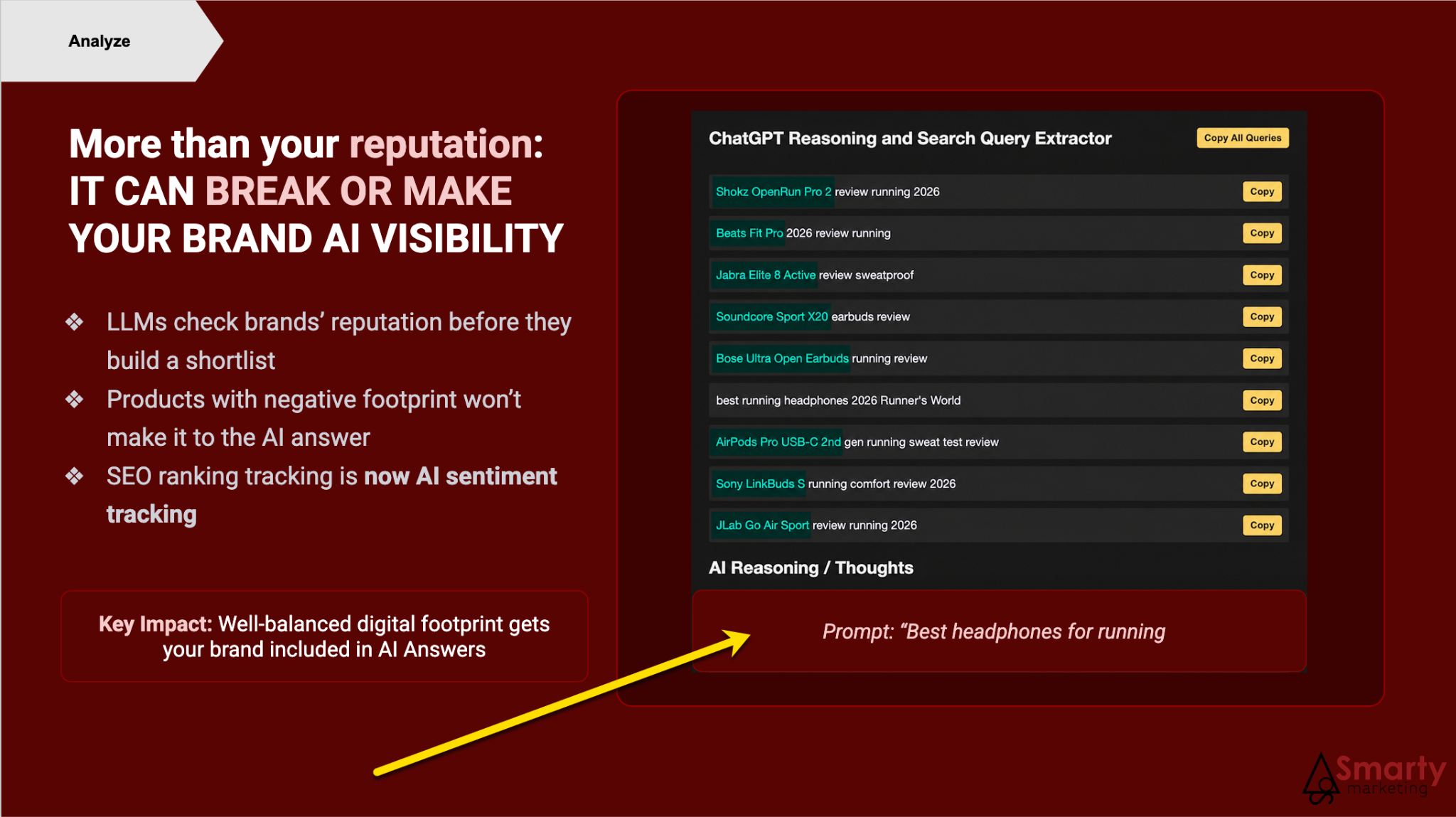
This is another insight we never had before: What LLMs search reflects what they know about your niche. These queries also often include brand and product names.
Your success metric is to start seeing your brand or product name included in the fanout queries. This is an even longer-term job than shifting the brand perception.
There are lots of free extensions and tools to analyze fan-outs. AI tracking dashboards do that too.
Bing’s new topic portfolio feature is another free place to look at:
To sum up: Actionable LLM metrics to track and audit for:
Brand attributes are visible, up-to-date, and correct
Brand objectives reflect the main selling points
You own the most influential channels for both
Your own channels are influential in category AI prompts, not just branded ones.
LLM fan-outs mention your brand or products (along with your competitors)
If you need help with your GEO/AEO audits or tracking, reach out. It is free.