

The Microsoft Advertising team has published a new guide on how to increase your visibility in AI answers.
>>> JOIN US to discuss this topic LIVE!
It was met with a lot of criticism from organic search professionals (we will discuss why), but there are a few cool and actionable tips there that reinforce what I (and many others) have been saying for years.
SEO vs GEO vs AEO
This is the first official guide implementing some new acronyms. While it is a good move, the guide did not do a good job distinguishing between the new ones, or explaining why we need those. According to Microsoft:
SEO = Keyword optimization
AEO = Answer Engine Optimization (easy answer retrieval)
GEO = Making your brand and content trusted by LLMs
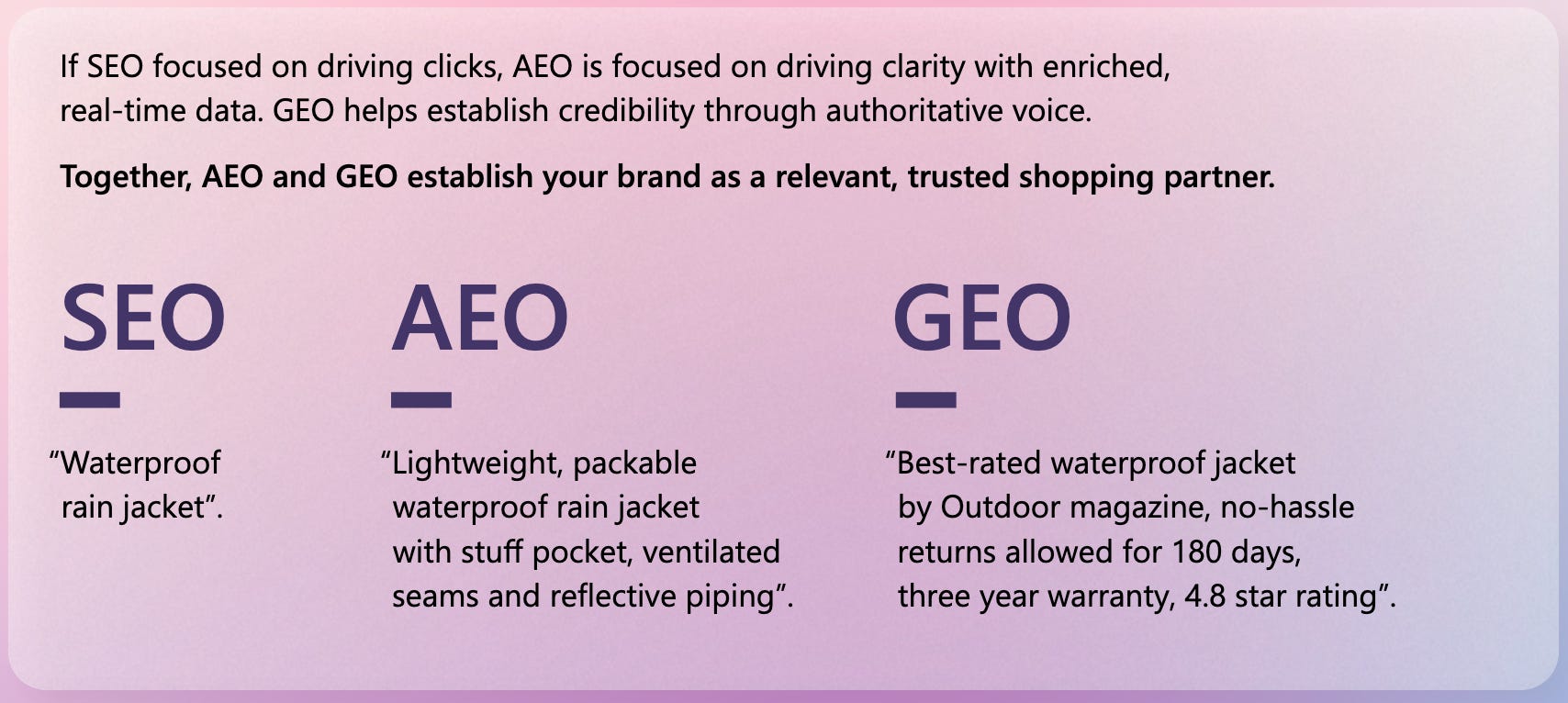
That’s a lot of acronyms for something we have been doing as “SEO” for years:
AEO is pretty much featured snippet optimization (we have been calling Google an answer engine since about 2014, and I have yet to see a clear explanation of how LLMs made those tactics any different, except for a new term - chunking - which also isn’t bringing anything essential new, simply calling the old good “make everything short, clear and factual” a new name)
GEO is pretty much EEAT optimization, as many of us already saw it.
Regardless, these definitions can be interpreted as follows:
AEO = on-page optimization
GEO = brand positioning.
This does not align with my earlier attempts to make sense of all the various acronyms, but I am ok with adjusting, if needed. We don’t evolve unless we change our opinions :)
An actionable checklist to be more visible
Healthy criticism aside (which I think is good for productive evolution), there are quite a few useful things in the guide, none of them being new:
You need to be more descriptive and intent-driven when optimizing your product pages (both on-page and in your product feeds). Keywords are no longer enough. You need to consider use cases and unique product/brand differentiators, i.e., “best for”.
Clear, bold claims work only if you can prove them. If you claim your product to be the best in a particular category, make sure to add why you are entitled to say so. “Best for XXX, according to XYZ”. LLMs are easy to be convinced if you state things clearly, but there’s an added layer of trustworthiness there.
Avoid exaggerated or unverifiable claims unless you can prove them by social proof or experts’ statements. “AI systems penalize low-trust language”. To be fair, I haven’t seen this in practice, but it might be something LLMs will be doing in the future.
Add text where you can - that includes detailed alt text for images and transcripts for videos.
Use Q&As or FAQs where they help provide more context and easier answer retrieval.
None of that is actually new to SEO, but LLMs are a little less mature and a little more human.
In short, make it as clear and convincing as you can. The way I explain it to clients: “LLMs are just like kids: They are easy to convince, but they follow the path of the least resistance. They won’t recommend you to your users unless your value proposition is very easy to understand and unless it is backed up by experts or social proof.”
There’s a repeated mention of schema, which states that structured markup helps without explaining how. My opinion about schema remains the same here: Use it, use it a lot.
When it comes to AI visibility, we don’t know how exactly LLMs may use schema, but it won’t hurt! And since LLMs turn to traditional search engines a lot, it will help because search engines use structured markup and may convince AI agents to click a rich result.
You can read the full guide here (it is not a lot).
It is funny (and sad) that we are excited to see any official guidelines at this point, even quite minimalistic. But so far, it is the most actionable we have!
Let’s talk if you need more than that.
totally agree that a lot of this feels like old wine in new bottles -- featured snippets and EEAT repackaged with sexier acronyms.
the part that actually IS new imo: how do you even know if it's working? in traditional SEO we had rankings, CTR, impressions. with LLMs recommending brands... how are you supposed to measure that? feels like we're optimizing in the dark.
anyone found a reliable way to track whether their "GEO" efforts are actually moving the needle in AI answers?
Not a fan of GEO as that is an SEO namespace already occupied by tactics related to ranking "location pages". Also the LLMs.txt NONSENSE is closely associated to GEO tactics.
Answer Engine Optimization describes what the results the are used for. I would argue that AEO prefers machine readable data so all structured data not just schema but also tabbed data like <tables>s, lists, and key value pairs created using punctuation like a ,(comma), ; or : that make key/value pairs